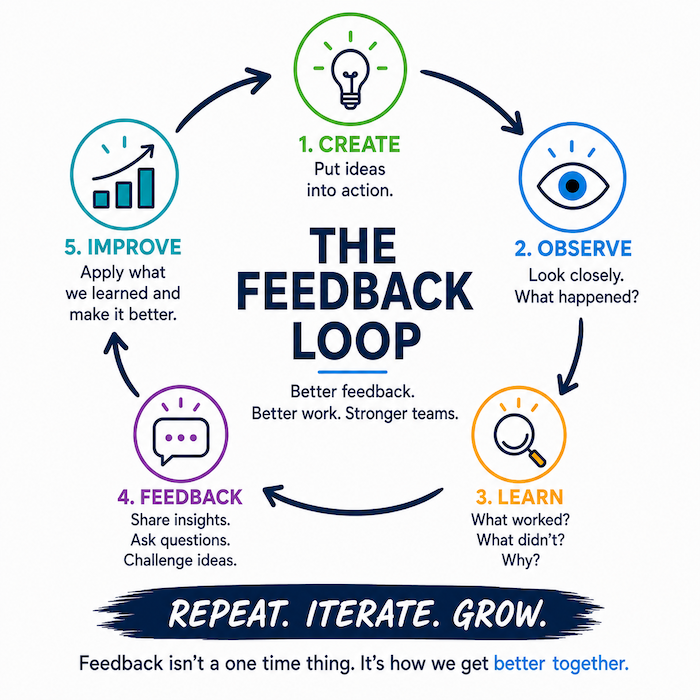
Why the Feedback loop is essential for taking progress to the next level. Have you heard of the feedback loop? It’s only been hiding in plain sight for years. It comes in the form of meeting minutes, lessons learned, retrospectives, stakeholder feedback, and now you can start adding your own to the mix.
So while feedback comes in various forms; there’s a big difference between doing stellar work for someone and helping them excel at the work themselves.
The difference is the feedback loop.
We are constantly seeing this in project management, Agile teams, leadership and increasingly in content creation. For example, a skilled Agile Coach doesn’t simply walk into a team fix the backlog, reorganize the sprint, facilitate every meeting and then leave. If you’re wondering why not, the job would be done, off to the next action item. It’s because if you’re always doing the work, you’re not necessarily coaching, you’re producing.
A Feedback Loop is the product of effective coaching.
If you think about what makes coaching valuable to begin with, it’s helping a team reach their optimum capability. It’s continuous feedback that leads to continuous improvement. And every time that loop happens, the team gets better at recognizing what works and what should possibly be worked on. Eventually they’ll start to catch it themselves, maybe even before the Agile coach brings it to their attention.
That’s real actionable progress in motion. Agile methodology institutionalizes this idea. Retrospectives occur because teams need to examine how they’re working. Sprint reviews evaluate what was produced, and we iterate because we don’t assume version one is going to be perfect. It’s all about building, observing, learning adjusting and repeating.
With this in mind, the same principle applies to teams.
The Feedback Loop must thrive for teams to build better talent.
One of the easiest traps for experienced project managers, agile coaches, consultants and leaders is to become the fix it all. The team views it as the optimal solution because you’re experienced and obviously know how to give it a quick fix. So you fix it, everyone is happy and tomorrow there is a new opportunity to fix something new, with a team that has no idea how to approach the situation. You keep solving every scenario, the team is entirely dependent on you and, and what may feel like high performance is just you “the coach” getting busier.
Strong leaders shouldn’t just correct the work, they should create feedback loops that continuously improves talent. If every rough draft gets immediately rewritten by the professional, the writer never really learns how to tell the story.